
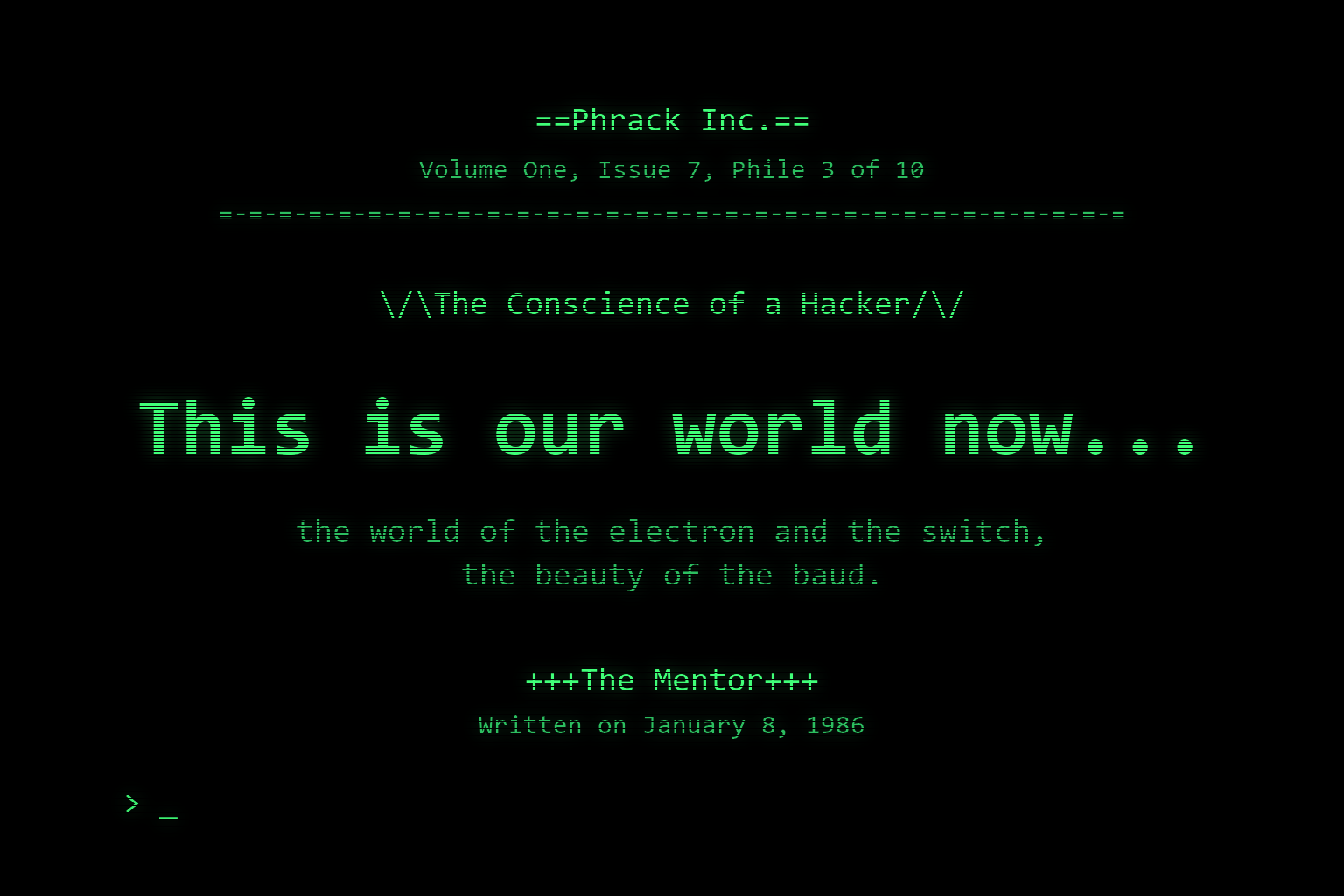
- Phrack issue 7, file 3 of 10
- Who The Mentor was
- What the manifesto says
- 1990, the year of the raids
- 1995, an arrest, a film and a book
- The sentences, from 1999 to 2012
- Money enters the game
- Ransom becomes an industry
- Working for a state
- Paid to find vulnerabilities
- MƆ's point of view
- Forty years on
- Sources and references
1. Phrack issue 7, file 3 of 10
On September 25, 1986, issue 7 of Phrack came out. Phrack is an electronic magazine first published in November 1985, and each issue is a set of text files.
The third file of issue 7 is called «The Conscience of a Hacker». It is one page long and signed with a nickname, The Mentor. In the Phrack archive it also appears under the title «Hacker's Manifesto».
It begins: «Another one got caught today, it's all over the papers». At the top of the page there is a date, January 8, 1986. According to Phrack, the author wrote it shortly after he was arrested.
The page can still be read in the Phrack archive. The world it described has changed a great deal since then, and today, alongside enthusiasts, there are gangs demanding million-dollar ransoms and groups attacking on behalf of a state.
A short glossary
- BBS (bulletin board system). A computer system for exchanging public messages and files, reached by dialling its phone number with a modem (a dial-up connection). The first public BBS, CBBS, went online in Chicago on February 16, 1978, set up by Ward Christensen and Randy Suess. In the manifesto it is «a board».
- Modem (modulator-demodulator). A device that converts a computer's digital signals into modulated analog signals suited to the phone line, and on the receiving end demodulates them back into digital data.
- Baud. A unit measuring symbols transmitted per second. It does not always match bits per second: a 300 baud modem sent 300 bit/s because each symbol carried one bit, while later modems carried several, for example 14,400 bit/s at 2,400 baud.
- Phrack. An e-zine, or electronic magazine, of the hacker scene, published since November 17, 1985. Each issue is split into text files called «philes».
- Phreaking. According to Encyclopaedia Britannica, the fraudulent manipulation of telephone signalling to make free calls. In the 1960s people found that some whistles reproduced the 2600 Hz tone the American phone network used for signalling, which travelled on the same channel as the voice.
- Legion of Doom and Masters of Deception. Two American hacker groups. The Mentor was a member of the Legion of Doom; the Masters of Deception were based in New York.
- Malware. Malicious software, written to damage a system, steal its data or take control of it.
- Banking trojan. Malware that installs itself covertly on the victim's computer to steal online banking credentials, for example by hijacking the browser or recording keystrokes (keylogging).
- Botnet. A network of computers infected by a type of malware called a bot, which makes them carry out the orders of whoever controls the network. Orders come from command-and-control (C2) servers or, in peer-to-peer botnets, pass from one infected computer to another with no central server.
- Ransomware. According to the U.S. agency CISA, malware designed to encrypt files on a device, rendering the files and the systems that rely on them unusable; attackers then demand a ransom in exchange for decryption. Many groups also publish victims' names and stolen data on dedicated leak sites.
- Vulnerability. A flaw in software or a system that an attacker can exploit to carry out unauthorised actions.
2. Who The Mentor was
Behind the nickname The Mentor was Loyd Blankenship. He was a member of two hacker groups, Extasyy Elite and Legion of Doom. The manifesto, however, carries only his signature and is not an official statement of either group.
In the text Blankenship does not explain why he was arrested. Right after the first line come two newspaper headlines: «Teenager Arrested in Computer Crime Scandal» and «Hacker Arrested after Bank Tampering». Next come the words of whoever reads those headlines, «Damn kids. They're all alike». The same line closes many paragraphs of the manifesto, spoken by people who judge the kid, such as the teacher convinced he copied his homework («Probably copied it») or someone complaining that he is tying up the phone line («Tying up the phone line again»).
The manifesto answers that judgement and tries to explain to those who see him as a criminal what drives a hacker.
3. What the manifesto says
The manifesto tells a story in the first person. It begins at school, where the author is bored: «I'm smarter than most of the other kids, this crap they teach us bores me».
Then comes the computer: «I made a discovery today. I found a computer». Unlike his teachers, the computer does not judge him, and if something does not work it is because of his own mistake.
The connection over the phone line is described like a drug: «rushing through the phone line like heroin through an addict's veins». When he finds a BBS, he writes: «This is it... this is where I belong...»
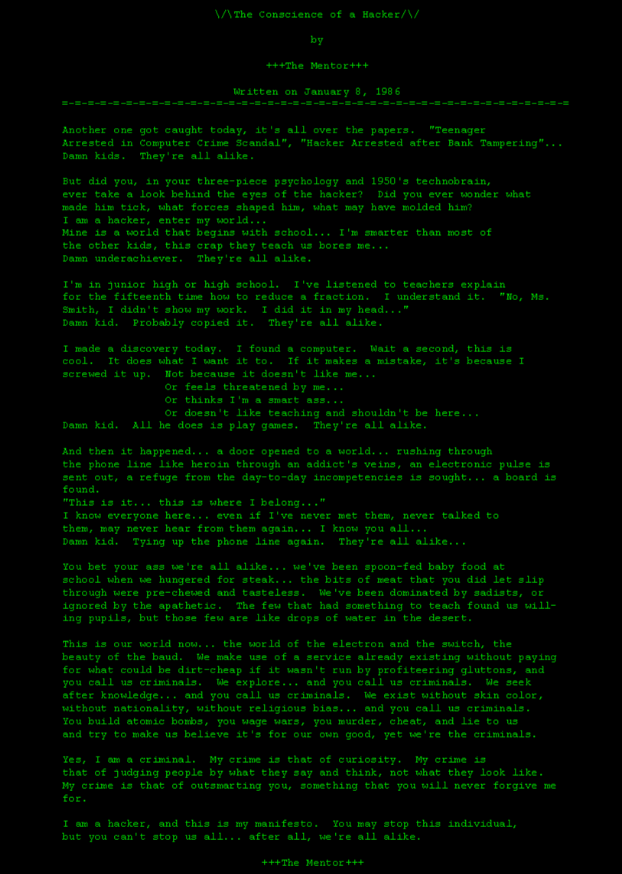
From here The Mentor speaks for all hackers. The move from «I» to «we» comes with «You bet your ass we're all alike», followed shortly by «This is our world now».
In the same paragraph «and you call us criminals» ends four sentences in a row, including these: «We explore... and you call us criminals. We seek after knowledge... and you call us criminals. We exist without skin color, without nationality, without religious bias... and you call us criminals».
Then he writes: «Yes, I am a criminal. My crime is that of curiosity». Right after that he adds that his «crime» is also judging people by what they say and think, not by how they look.
The last line is a challenge: «You may stop this individual, but you can't stop us all... after all, we're all alike». These are the same words others used with contempt in the first paragraphs, now spoken by hackers with pride.
Two years earlier, in 1984, the journalist Steven Levy had described in his book Hackers: Heroes of the Computer Revolution a hacker ethic in which access to computers should be «unlimited and total». The Mentor's manifesto can be compared with that idea.
4. 1990, the year of the raids
On March 1, 1990, Secret Service agents entered the offices of Steve Jackson Games in Austin, Texas, a company that publishes role-playing games. The Secret Service is a federal agency separate from the FBI, created to fight currency counterfeiting; it protects the president, carries out criminal investigations and in 1990 was part of the Treasury Department. The agents took away four computers. They also searched the home of Loyd Blankenship, who now worked there and had written the game GURPS Cyberpunk. According to the company, Steve Jackson Games was involved only because Blankenship was one of its employees.
Two months later, between May 7 and 9, 1990, the Secret Service launched Operation Sundevil. About 150 agents carried out searches in around fifteen American cities. About 42 computers were seized, and about 25 of them were running BBSes. It was the most publicised action against hackers in the United States up to that point. There were three or four arrests, depending on the source. The writer Bruce Sterling, in his book The Hacker Crackdown, estimates that the operation hit about one in a thousand American BBSes.
Steve Jackson Games later sued and won. The court called the Austin raid «careless, illegal, and completely unjustified». The company received more than 50,000 dollars in damages and more than 250,000 dollars in legal costs.
The Electronic Frontier Foundation was created to respond to cases like this one. It is an organisation that defends digital rights. It was founded by Mitch Kapor, John Perry Barlow and John Gilmore, and it paid for the lawsuit. At the heart of the case were the rights of people who are not accused of anything and have their computers seized by federal agents.
5. 1995, an arrest, a film and a book
On February 15, 1995, the FBI arrested Kevin Mitnick in Raleigh, North Carolina.
On September 15 the film Hackers, directed by Iain Softley, opened in cinemas. In the film you can hear The Mentor's line «This is our world now...».
In the same year two journalists from the newspaper Newsday, Michelle Slatalla and Joshua Quittner, published the book Masters of Deception: The Gang That Ruled Cyberspace with Harper Perennial. The book tells the story of a rivalry in New York between two groups, the Masters of Deception and the Legion of Doom, Blankenship's group. This rivalry became famous as the «great hacker war» of 1990 and 1991. Not everyone recognises it, though, and the hacker known as Phiber Optik called it «a complete fabrication».
6. The sentences, from 1999 to 2012
On August 9, 1999, the U.S. Department of Justice announced Mitnick's sentence of 46 months in prison, plus another 22 months decided in a separate case. Mitnick left prison in January 2000. He died on July 16, 2023.
Jonathan James, from Miami, known online as «c0mrade», had breached NASA systems, among others. In 2000, at 16, he was sentenced to six months in a detention facility. On September 21, 2000, the Department of Justice wrote that it was the first time a juvenile hacker had been sent to detention.
A few months earlier, on March 23, 2000, Raphael Gray, known online as «Curador», had been arrested in Wales. He had been tracked down by a former hacker, Chris Davis. Gray had stolen more than 26,000 credit card numbers from online shops.
Then there is the British hacker Gary McKinnon. He was accused of unauthorised access to NASA and Pentagon computers in 2001 and 2002. For years the United States asked for him to be handed over for trial. On October 16, 2012, British Home Secretary Theresa May refused, because of the risk that he would take his own life.
7. Money enters the game
From here the story takes three directions that lead up to today, covered in the sections that follow: organised crime, which uses hacking to steal money; states, which use it for their own interests; and paid research, with experts hired or rewarded to find vulnerabilities before the criminals do.
On the criminal side there is Evgeniy Bogachev. According to the U.S. Department of Justice, Bogachev led the gang behind GameOver Zeus, a botnet used to steal banking credentials from infected computers and also to distribute CryptoLocker, a piece of ransomware. Unlike classic botnets, GameOver Zeus had a peer-to-peer architecture, with no single central server to shut down.
On June 2, 2014, the Department of Justice announced Operation Tovar, an international action that cut the communications between infected computers and the infrastructure used to control them. On the same day it unsealed Bogachev's indictment in Pittsburgh, with 14 counts, including conspiracy, computer hacking, wire fraud, bank fraud and money laundering.
Bogachev is still on the FBI's list of most wanted cyber criminals, the Cyber's Most Wanted, and the U.S. Department of State has announced a reward of up to 3 million dollars for help in arresting or convicting him.
8. Ransom becomes an industry
Five years after Operation Tovar, in December 2019, the United States went after a Russian criminal organisation. The Department of the Treasury sanctioned Evil Corp and its leader, Maksim Yakubets. According to the Treasury, Evil Corp created and spread Dridex, a banking trojan that harvested login credentials from banks and financial institutions in more than 40 countries, with losses of over 100 million dollars. According to the U.S. agency CISA, Dridex spreads mainly through phishing emails, infiltrates the browser, detects access to online banking sites and steals credentials, including through keylogging.
A reward of up to 5 million dollars was announced for Yakubets. According to the FBI it was the largest reward ever offered up to then for a cyber criminal.
In the same years ransomware grew. According to the analytics firm Chainalysis, in 2023 victims paid 1.25 billion dollars in cryptocurrency, the highest amount ever recorded. In 2024 payments fell by 35%, to about 814 million. The drop came from law enforcement operations against groups such as LockBit and BlackCat, and from more victims refusing to pay. The attacks did not go down, however, and the number of victims posted on leak sites reached an all-time high.
9. Working for a state
In 2017 the WannaCry ransomware infected computers in about 150 countries. On December 19, 2017, the White House officially stated that North Korea was behind the attack. Tom Bossert, the president's homeland security adviser, wrote that the attack had caused billions of dollars in damage. The United Kingdom, Australia, Canada, New Zealand and Japan joined the accusation. North Korea has always denied it.
Around February 21, 2025, the cryptocurrency exchange Bybit lost about 1.5 billion dollars in virtual assets to theft. On February 26 the FBI published an official alert. According to the FBI, North Korea was again behind the attack, through an operation called TraderTraitor, linked to the Lazarus Group.
In the same alert the FBI asked cryptocurrency platforms to block transactions with the addresses used to launder the funds. Part of it had already been converted into bitcoin and other virtual assets and dispersed across thousands of addresses on multiple blockchains. According to the American authorities, in both cases the attackers were acting on behalf of the North Korean government.
10. Paid to find vulnerabilities
Many companies and public bodies run «bug bounty» programmes, which pay people who find a vulnerability in their systems and report it instead of exploiting it.
In 2016 even the U.S. Department of Defense, headquartered at the Pentagon, did it with the «Hack the Pentagon» programme. From April 18 to May 12, 2016, participants were allowed to legally test some of the department's public websites, excluding the most sensitive systems. 1,410 people took part. The first report arrived 13 minutes after launch. In the end there were 138 valid, unique vulnerabilities, and according to HackerOne, the platform that ran the programme, about 75,000 dollars in rewards were paid.
According to HackerOne's annual report, between July 2024 and June 2025 hackers received 81 million dollars through the platform, 13% more than the year before. On average each reward was worth 1,090 dollars. Vulnerabilities in artificial intelligence systems alone earned more than 2.1 million dollars.
11. MƆ's point of view
Do hackers today care only about money and no longer about ethics? The 1986 manifesto already opened with a headline about an arrest for bank tampering, and even then the same skills served very different ends.
What has changed is the sums and who pays them. Through ransomware, organised crime took more than a billion dollars in a single year, the United States attributes a 1.5 billion dollar theft to North Korea, and authorised research pays tens of millions of dollars to people who report vulnerabilities. Money flows everywhere, and what separates one kind of work from another is who commissions it and whether it is permitted.
That is why «my crime is that of curiosity» explains little today. In cybersecurity curiosity is useful, because the work consists of observing, forming hypotheses and testing them. A penetration test, a simulated and authorised attack, differs from an intrusion by permission: whoever runs it knows which systems they may touch, who asked for it and where they must stop.
The Austin raid shows what happens when the authorities hit people who were not accused of anything, while the cases of Mitnick, James, Gray and Bogachev are a reminder that on the other side there are people and companies who suffer real damage.
12. Forty years on
With the arrival of the web, from the mid-1990s, BBSes lost most of their users. Phrack, however, is still active. On August 19, 2025, it published issue 72 to celebrate its fortieth anniversary. It presented it at three big hacker gatherings: WHY2025 in the Netherlands, DEF CON 33 in Las Vegas and HOPE in New York.
In its archive The Mentor's page is still in its place, in issue 7, file 3 of 10.
Sources and references
- Phrack, The Conscience of a Hacker / Hacker's Manifesto.
- Phrack issue 7, index and introduction.
- Loyd Blankenship; Red Hot Cyber, The Hacker Manifesto.
- Steve Jackson Games, The Secret Service Raid.
- Hackers (film).
- Publishers Weekly, Masters of Deception.
- Great Hacker War.
- Kevin Mitnick; Department of Justice, sentence announcement; Deseret News, release; CSO, Mitnick's death.
- Department of Justice, Jonathan James; Deseret News, Jonathan James.
- CNN, Raphael Gray; The Register, Raphael Gray.
- NPR, Gary McKinnon.
- Steven Levy, Hackers: Heroes of the Computer Revolution.
- United States Department of State, Evgeniy Bogachev; Department of Justice, Reward Announced for Cyber Fugitive; CBS News, Bogachev.
- FBI, charges announced in malware conspiracy.
- Bulletin board system; IEEE Spectrum, The Bulletin Board System: Social Media's Dial-up Roots.
- Encyclopaedia Britannica, phreaking; Phreaking.
- Phrack.
- Department of the Treasury, Evil Corp sanctions.
- TechTarget, Chainalysis: 2024 ransomware payments.
- SecurityWeek, Ransomware payments dropped to 813 million in 2024.
- FBI, alert I-022625-PSA on Bybit and North Korea.
- HackerOne, Hacker-Powered Security Report.
- Phrack, issue 72; WHY2025, Phrack 40th Anniversary Release; HOPE 16, Phrack Magazine #72 Release Party.
- Operation Sundevil.
- Bruce Sterling, The Hacker Crackdown, part 3.
- Department of Justice, GameOver Zeus and Cryptolocker, June 2, 2014.
- White House, attribution of WannaCry to North Korea, December 19, 2017.
- HackerOne, Hack the Pentagon.
- CISA, Ransomware 101.
- CISA, advisory AA19-339A on Dridex.
- Encyclopaedia Britannica, modem.
- ENISA, glossary: botnets.
- George Mason University, Baud versus bits per second.
Note on levels of evidence. Primary sources include Phrack, Steve Jackson Games and government statements or pages. Other accounts are attributed to their respective publications. Rewards are reported as announced by the U.S. Department of State, the FBI and the U.S. Department of Justice.