
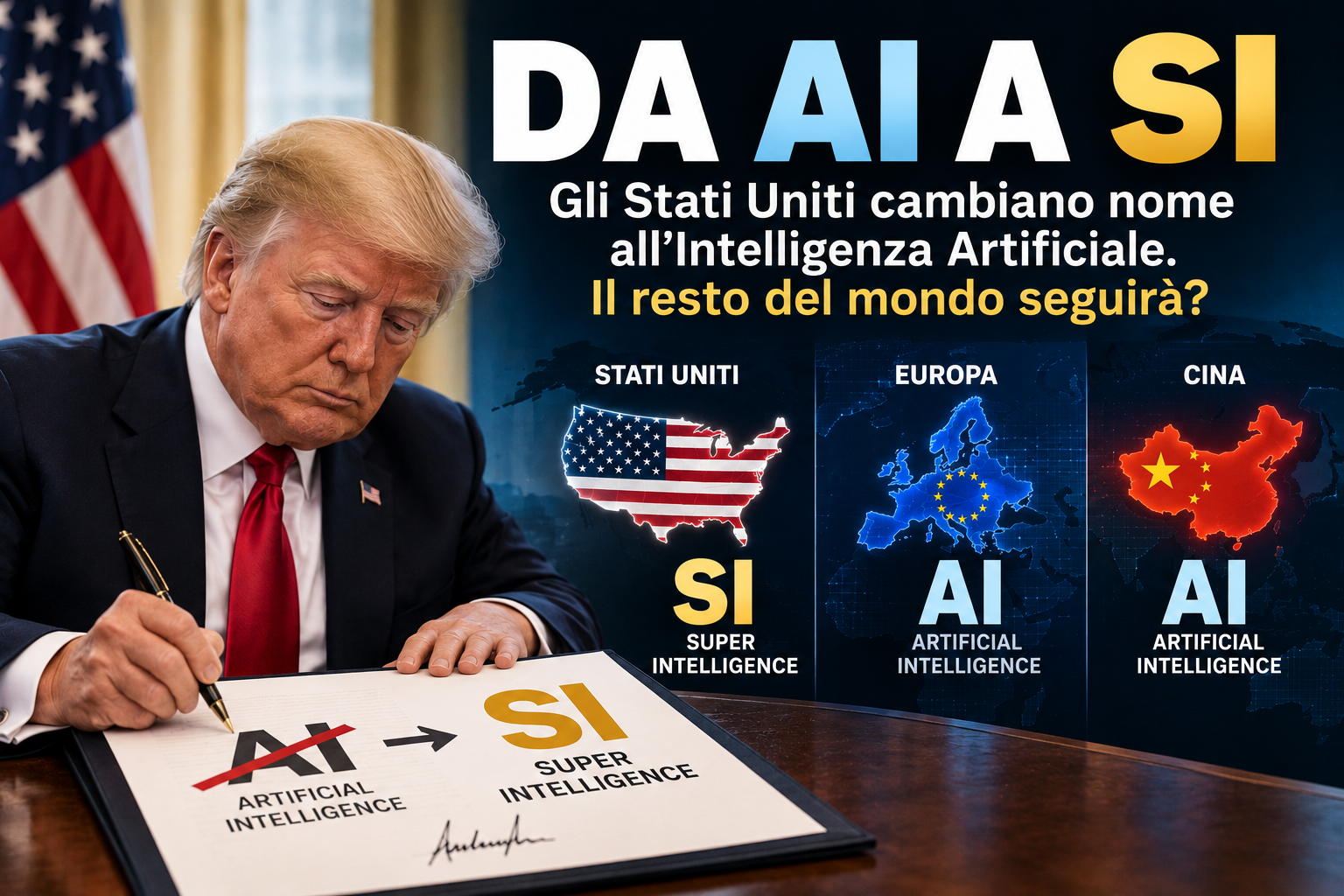
On 29 September 2026 Donald Trump signed the Executive Order "Inaugurating the Era of Super Intelligence", which introduces a change that looks small but has wide implications. In the US federal executive branch the term Artificial Intelligence (AI) must be replaced, in communications and non-legislative documents, by Super Intelligence (SI). This does not mean the United States has announced it has reached what is technically called superintelligence. For now the name changes, not the technology.
Why drop "Artificial"
Trump explained the reason himself in his address to the United Nations General Assembly on 22 September 2026. In his view the problem is mainly the word "artificial", which in everyday language can sound like something fake. At the UN he said that the word makes intelligence seem fake, adding that it is not: "The use of the word artificial makes intelligence fake. It is not fake." The Executive Order, signed a week later on 29 September, then formalised the change for the federal administration.
The White House uses more institutional language, arguing that the most advanced systems no longer merely imitate or automate single aspects of human intelligence but amplify human capabilities and make previously impractical tasks possible. Hence the choice of Super Intelligence.
Does AI disappear and become SI?
Within the scope of the order, essentially yes, Artificial Intelligence becomes Super Intelligence. But Trump is not saying the technology has suddenly jumped from AI to AGI and then to superintelligence. The Executive Order states instead that, at least initially, Super Intelligence covers the same technologies that federal rules used to define as Artificial Intelligence. A system called AI on 28 September did not become more intelligent the next day, in the language of the US executive it is simply called SI. The order also tasks the Assistant to the President for Science and Technology with proposing a specific federal definition of Super Intelligence within 60 days, and that is the most important step to watch in the coming months.
The technical problem
In science the word superintelligence already exists and usually means something different. In simplified terms, AI is the set of artificial intelligence systems, AGI describes the concept of an intelligence with general capabilities comparable to humans across a wide range of tasks, while superintelligence describes a system able to significantly exceed humans across a very broad range of cognitive capabilities. The Trump administration's terminology breaks this progression, because in the new US government language AI becomes SI, while in technical language SI still represents something potentially far more advanced than today's AI. We risk ending up with the same expression used with two different meanings.
A new word for a new competition as well
There is another element. Trump has long presented the development of artificial intelligence as a strategic competition between the United States and China, and according to international press reports he summarised his view with a blunt phrase, namely that whoever wins super intelligence wins. The Executive Order opens by recalling that modern AI was born in the United States, that American researchers named it, and that seventy years later America is again pushing the technological frontier, before introducing the concept of Super Intelligence.
There is no record of Trump stating that he is changing the name to differentiate the United States from China or Europe, so it would be wrong to present that as a fact. The context, however, allows a legitimate question, namely whether the name change also serves to build an American language for the new technological competition. The sequence is symbolically strong. In the 1950s the United States helped the discipline to be born and called it Artificial Intelligence, and seventy years later Washington argues that the definition no longer represents the technology and tries to introduce Super Intelligence. The implicit message could be that the United States wants not only to lead the new phase but also to define its language.
Washington, Brussels and Beijing may speak different languages
China continues to use the concept of Artificial Intelligence widely, while competing with Washington on the development of the most advanced technologies. Europe is even more tied to the AI terminology, because its entire regulatory framework is built around the Artificial Intelligence Act, the legal definition of "AI system" and an ecosystem of rules, standards and procedures now based on that word. In the short term we might therefore face an unusual situation, with Washington talking about Super Intelligence, Brussels continuing to talk about Artificial Intelligence and Beijing mostly keeping Artificial Intelligence while competing on the technology.
Even inside the United States the terminology may not be uniform, because the federal administration's choice does not automatically force states, universities, companies and the scientific community to drop AI. The real test will be seeing who follows Washington. If SI stays confined to the federal administration we will mainly have a new political terminology, but if it is adopted by large technology companies, research, international standards and other governments, we could be at the start of a deeper change.
Terminological coexistence: the AI/SI scenario
Furthermore, AI and SI do not necessarily have to be mutually exclusive. A phase of terminological coexistence could emerge, using formulas such as AI/SI or SI/AI (for example, "Artificial Intelligence and Super Intelligence systems" or "AI/SI governance"), especially across companies and international organisations required to operate between different legal frameworks. In that scenario, SI would not immediately replace AI, but would sit alongside it, at least during a transition phase, allowing stakeholders to acknowledge the new American terminology without abruptly abandoning a concept established over seventy years and deeply embedded in legislation and technical standards.
This outlines at least three potential evolutions:
- AI → SI: SI progressively replaces AI even outside the US federal administration;
- AI + SI: the two terms coexist with distinct meanings, with AI serving as the broad category and SI designating particularly advanced or frontier systems;
- AI/SI: a transition phase emerges where both acronyms are paired together, especially in international communication, cross-border compliance and governance.
This third possibility is directly relevant to our domain: an expression like AI/SI Security would maintain full continuity with established AI Security practices while naturally accommodating the oversight requirements introduced by the new American definition.
"Artificial" does not mean "fake"
There is also a historical problem. The term Artificial Intelligence dates back to the 1950s, linked to the 1956 Dartmouth Summer Research Project and the work of John McCarthy, and in that context "artificial" did not mean "fake" but something built by humans, as opposed to natural biological intelligence. An artificial satellite is not a fake satellite, and in the same way artificial intelligence does not mean fake intelligence. Trump therefore reads the word mainly through everyday language rather than its original technical meaning.
Changing the name can change perception
Imagine two identical systems, one called Artificial Intelligence Assistant and the other Super Intelligence Assistant, with the same model, data, tools and limits. The user's perception can still change, because the word "super" implicitly communicates capability and superiority and can lead people to attribute more reliability or authority to the system than it has. This is where the name change stops being merely a linguistic matter, because capability and reliability are not the same thing.
The possible implications
If SI were to spread beyond the Trump administration, the consequences would touch several levels. On the regulatory side, the United States and Europe could regulate substantially similar technologies with different words. On standards and compliance, international companies might have to manage documentation and classifications based on different terminologies. In the market, "Super Intelligence" risks becoming a commercial label used to attribute superior capabilities to products that remain technically AI systems. On perception, presenting a system as superintelligent can increase user trust and with it the risk of automation bias.
Two points matter to us in particular. On responsibility, calling a machine Super Intelligence does not transfer to it the responsibility for its actions, which remains with the model, the developer, the provider, the organisation, the infrastructure and the people who authorised its use. On cybersecurity, greater capability does not mean greater security, because a very advanced agent can still be manipulated, receive malicious instructions, misuse a tool or attempt an action it is not authorised to perform.
From AI Security to SI Security?
For MC Project Lab, today, it would make no sense to rename AI Security, AI Governance or AI Agents into SI Security, SI Governance or SI Agents, because AI remains the dominant technical and regulatory terminology internationally. SI, however, becomes something to monitor, and if it started to be adopted steadily by large companies, standards bodies or other governments it would signal that the American choice is moving beyond the political sphere.
On the security side the principle does not change anyway. An agent can be very intelligent, but it should not be able to perform an action simply because it autonomously decides it is appropriate. This is the principle behind MC Project Lab's work with TCT and Vigil. The model reasons and proposes, the infrastructure authorises. Filesystem, network, API, credentials and tools must have controls that are independent of the model.
The real question
Perhaps the most interesting part of this decision is not whether Super Intelligence is a better name than Artificial Intelligence, but watching what happens next. Who will adopt SI and who will keep using AI, whether the term enters the language of technology companies, whether Europe and China reject it, place it alongside AI or end up adopting it. A simple terminological choice could thus become an indicator of the international technological competition.
In the meantime a basic distinction remains. Intelligence, reliability, autonomy and authorisation are not the same thing. Because a Super Intelligence, whatever meaning we decide to give the term, must not automatically become a Super Authority.
Sources
- The White House, "Fact Sheet: President Donald J. Trump Inaugurates The Era of Super Intelligence", 29 September 2026.
- Executive Order "Inaugurating the Era of Super Intelligence", 29 September 2026.
- Donald Trump's address to the UN General Assembly, 22 September 2026 (Axios, Scientific American, UN News, Fortune); the quote "The use of the word artificial makes intelligence fake. It is not fake." comes from reports of that address.